
I have been quietly obsessed with space exploration since I watched a rocket launch on a grainy screen as a kid. What still amazes me is how much has changed just in the last few years. This guide is my attempt to share that fascination in plain language — a beginner-friendly tour of how we got to space, what we are doing up there now, and why it matters more than most people realise.
Space exploration is one of humanity's most ambitious and inspiring ongoing endeavours. From the first satellite launched into orbit to rovers currently trundling across the Martian surface, we have extended our reach further than most people alive in 1900 could have imagined. If you are new to the subject, the sheer scale of the universe can feel overwhelming. This guide starts from the beginning — what space exploration actually is, why we do it, how the major milestones got us here, and how you can start following the extraordinary events unfolding right now.
What Is Space Exploration?
Space exploration is the investigation of outer space using astronomy and space technology. It covers both crewed missions — where astronauts physically travel beyond Earth — and uncrewed missions, where robotic spacecraft, probes, and telescopes gather data and transmit it back to Earth.
The field is driven by both scientific curiosity and practical imperatives: understanding the origins of the universe, searching for life elsewhere, and developing technologies that benefit everyday life on Earth. From GPS navigation to the insulating materials in your jacket, space research has produced more terrestrial spinoffs than most people realise.
A Brief History of Space Exploration
The Space Race (1957–1969)
The modern era of space exploration began on 4 October 1957, when the Soviet Union launched Sputnik 1 — the first human-made object to orbit Earth. The bleeping radio signal it transmitted was heard around the world, triggering the Space Race between the United States and the Soviet Union.
Key milestones of this era include:
- 1957 — Sputnik 1, first satellite (Soviet Union)
- 1961 — Yuri Gagarin becomes the first human in space (Soviet Union)
- 1963 — Valentina Tereshkova becomes the first woman in space (Soviet Union)
- 1969 — Apollo 11: Neil Armstrong and Buzz Aldrin become the first humans to walk on the Moon
The Shuttle Era and International Space Station (1981–present)
NASA's Space Shuttle programme (1981–2011) made space access more routine. The International Space Station (ISS), assembled in orbit from 1998 onwards, became a permanent laboratory where astronauts from dozens of countries have conducted continuous scientific research since November 2000.
The New Space Era (2010s–present)
The last decade transformed space exploration from a government monopoly into a commercial industry. SpaceX's reusable Falcon 9 rockets dramatically cut launch costs. Private companies — Blue Origin, Rocket Lab, Virgin Galactic — entered the market. Space tourism became reality in 2021 when civilians flew to orbit for the first time.
The Scale of Our Universe
One of the most mind-expanding aspects of learning about space is grasping the sheer distances involved. Some comparisons to help contextualise the scale:
| Journey | Distance | Travel Time at Light Speed |
|---|---|---|
| Earth to Moon | 384,400 km | 1.3 seconds |
| Earth to Sun | 150 million km | 8.3 minutes |
| Earth to Mars (average) | 225 million km | 12.5 minutes |
| Earth to nearest star (Proxima Centauri) | 4.24 light-years | 4.24 years |
| Across the Milky Way | ~100,000 light-years | 100,000 years |
Key Concepts Every Beginner Should Know
Orbit
An orbit is the curved path an object follows around a larger body due to gravity. The ISS orbits Earth at roughly 400 km altitude, completing a full orbit every 90 minutes. Geostationary orbit (35,786 km) matches Earth's rotation — satellites placed there stay above the same point on the ground, which is why they are used for TV broadcast and weather monitoring.
Launch Vehicles and Rockets
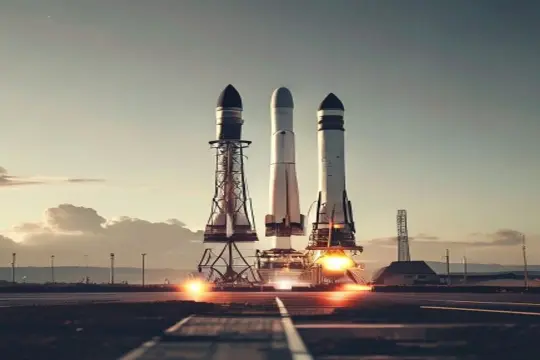
Rockets work by expelling mass (exhaust gas) in one direction, propelling the vehicle in the opposite direction — this is Newton's Third Law of Motion. Modern rockets use liquid propellants (liquid hydrogen and liquid oxygen, or kerosene and liquid oxygen) that produce enormous thrust. Reusable rockets, pioneered by SpaceX, land their boosters after launch and fly again, dramatically reducing costs.
The Solar System
Our solar system contains eight planets orbiting the Sun, along with dwarf planets (including Pluto), moons, asteroids, and comets. The inner planets (Mercury, Venus, Earth, Mars) are rocky; the outer planets (Jupiter, Saturn, Uranus, Neptune) are gas or ice giants. The four outer planets all have ring systems, though Saturn's are by far the most spectacular.
How to Follow Space News Today
Space exploration moves fast. Here are the most reliable and accessible ways to stay informed:
- NASA.gov — Comprehensive mission updates, imagery, and educational resources. The NASA App and NASA TV stream launches live.
- SpaceX (x.com/SpaceX) — Real-time updates on launches, including spectacular landing footage.
- ESA (esa.int) — European Space Agency's mission portfolio including Mars Express and the James Webb telescope contributions.
- Sky & Telescope (skyandtelescope.org) — Excellent for amateur astronomy alongside professional space news.
- The Planetary Society — Member organisation focused on space exploration; great newsletter.
For the latest developments in space technology in 2026, see Space Exploration Trends 2026: The New Space Race and explore our Science section for related coverage. And to understand how space research connects to your everyday technology, read How Space Technology Affects Your Everyday Life.
FAQ
How far has humanity travelled from Earth?
The Apollo astronauts who walked on the Moon — 384,400 km from Earth — represent the furthest any human has physically travelled. The Voyager 1 spacecraft, launched in 1977, is the furthest human-made object, now over 23 billion kilometres from Earth and still transmitting data.
Is there life elsewhere in the universe?
We have not yet found evidence of life beyond Earth, but the search is active. The discovery of liquid water beneath the surface of Mars, subsurface oceans on Jupiter's moon Europa, and thousands of exoplanets in habitable zones has made astrobiologists optimistic that life, at least microbial life, may exist elsewhere. The James Webb Space Telescope is currently analysing exoplanet atmospheres for biosignatures.
How do astronauts survive in space?
The ISS provides a pressurised, temperature-controlled environment with breathable air recycled from CO₂ and water. Astronauts exercise for two hours daily to counteract muscle and bone loss caused by microgravity. Space suits provide life support and radiation protection for spacewalks. Food, water, and supplies are delivered by cargo spacecraft every few months.
Can ordinary people go to space?
Space tourism is commercially available in 2026, though extremely expensive. SpaceX has carried private passengers to orbit; Blue Origin and Virgin Galactic offer suborbital flights. As competition drives launch costs down, broader access is expected over the coming decade.
Why This Still Gives Me Chills
We are, right now, driving robots on another planet and catching rockets out of the sky to reuse them. A generation ago that was pure science fiction. Whenever the news feels heavy, I find something genuinely hopeful in remembering what humans are quietly pulling off just above our heads.
Conclusion
Space exploration is both a scientific discipline and a profoundly human endeavour. It pushes the limits of engineering, generates knowledge that benefits life on Earth, and answers some of our oldest questions about our place in the universe. Whether you are driven by curiosity about the cosmos, interest in the technology, or the sheer wonder of looking up at a clear night sky, you are joining a long tradition of people who refused to be content with only knowing what was within reach.
Start with the resources above, follow a live rocket launch, and let the scale of what we have already achieved — and what remains to be discovered — inspire you.
Fellow space enthusiast? I would love to compare favourite missions. — Hemant


Leave a comment
Your email address will not be published. Required fields are marked *